Our journey to Global Orthopedics
How it began
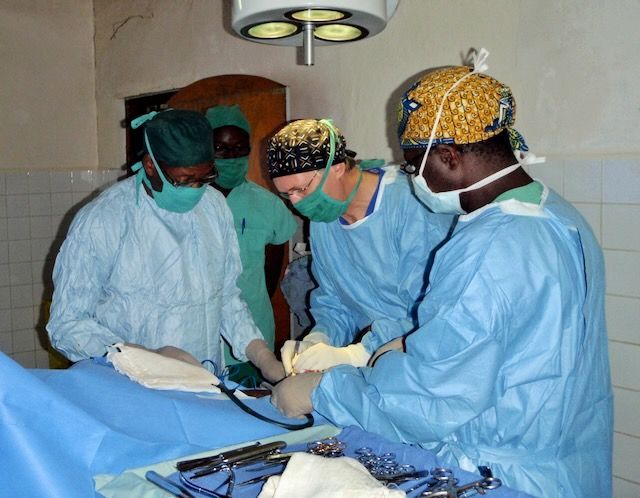
The five years in the 200-bed hospital in the Cameroon Littoral Province focused on the organization of a medical district. Surgery, gynecology, pediatrics and tropical medicine were practiced in the hospital. In the medical district with 5 dispensaries and 10-15 village health workers organization of drugs and medical supplies, standardization of treatment protocols, vaccination campaigns and supervision were the activities. The two volumes of 'Primary Surgery', edited by Maurice King, brought me on the surgical path.
Getting familiar with orthopedic surgery under austere conditions
Having heard from the
SIGN nailing technique
I got in contact with SIGN Fracture Care International. They organized a short-term fellowship with the trauma surgeons at Muhimbili Orthopedic Institute at Dar es Salaam. They are the most experienced SIGN surgeons. I saw many different long-bone fractures treated without C-arm and therefore with open reduction.
Another valuable insight into a well-organized hospital with competent staff we got at United mission Hospital Tansen in Nepal. In a second visit we were able to work in the hospital and replace Nepali surgeons, treating earthquake victims in the disaster zone.
Volunteering in different places
In the Lutheran Hospital at Ngaoudéré in
Cameroon
I helped introduce the SIGN nailing technique. Nails of course, are not the solution to everything. We had cases for external fixation, hand and reconstructive surgery, the latter done by Nicola.
Several trips to
Madagascar
brought us in close contact to the Malagasy doctors of the Health Department of the Malagasy Lutheran Church. Workshops on hospital administration, use of external fixator, ultrasound for surgery, gynecology and obstetrics as well as regional anesthesia techniques were organized. This was the base of friendships for years.
At St. Orsola Hospital in Matiri,
Kenya
I have been twice. The enormous caseload of trauma patients is managed by an skilled and charismatic Italian catholic father and surgeon. He is Kenya's most experienced SIGN surgeon.
Invited by a dedicated young German orthopedic surgeon to the Protestant Hospital of Mbouo in the Bamileke region of
Cameroon, I realized that a Hospital Partnership can shape a health system.
Nicola has twice been to
Guatemala with a German Interplast Team, led by the lat Dr Günter Zabel, her teacher at the Department of Hand and Plastic surgery at the Schopfheim Hospital. The focus of these missions was on reconstructive surgery.
With Doctors without Borders (MSF) in the Central African Republic
In the capital of the civil war ridden Central African Republic MSF runs the SIKA-Hospital. There I was exposed to war surgery for the first time. We had to treat mainly gunshot wounds, beside high-velocity injuries from car or motorbike accidents. With no C-arm available and external fixator and K-wires as the only orthopedic implants, the surgeons had to exploit the full potential of the external fixator. Beside these limitations the MSF hospital is well organized with treatment standards and SOPs for many procedures. An antibiotic stewardship program is established and was run by a skilled CAR doctor. We could rely on a well-equipped physiotherapy department with a qualified team. Security is always a concern in MSF hospitals, as they are located in zones of war or unrest.
Partnership Doctors for Madagascar - Malagasy Lutheran Hospitals
In January 2023 Dr. Harison, the medical director of the Andranomadio Lutheran Hospital in Antsirabe, organized a 3-weeks workshop for the doctors from the six different hospitals. The goal was to train a future generation of young surgeons. The workshop consisted of lectures, practical exercises and assisted surgery. The focus was on general surgery, orthopedic trauma, hand surgery and radiology. Together with friends from our region (a general surgeon and a radiologist) we were part of the team. Surgery for orthopedic trauma is possible at Andranomadio hospital, but due to lack of basic instruments and implants, not at the other hospitals.
As a result of the course, a
Hospital Partnership was established that brought together the German NGO 'Doctors for Madagascar' and the Health Department of the Malagasy Lutheran Church (SALFA). Doctors for Madagascar has worked together with SALFA over many years and in various partnership programs, that were centered on the SALFA hospitals and dispensaries in the poor southern part of the island. Our Partnership wants to improve access to basic orthopedic care for trauma patients.
Context-adapted equipment
has been purchased from an Indian Manufacturer. This strategy makes supplies more accessible for health systems with limited financial resources and allows a supply chain to be established.
A
training workshop in 2024 and 2026
combined lectures and practical exercises. The participants were medical doctors in charge of surgery and the nurses of the OR-team. By giving them the same training opportunity, we hope to strengthen the team approach.
A
follow-up visit
in the end of 2025 showed, that only hospital with x-ray equipment were able to provide orthopedic trauma care. The visit was an opportunity to evaluate other areas of equipment needs: some autoclaves were out of service or of poor performance, ansesthesia machines lacked of vaproizers for isoflourane and sevoflourane, electrosurgical units ware run down with lack of neutral electrodes. This situation is certainly due to a lack of funds but also to the absence of maintenance teams. A project initiative for the creation of a
SALFA Boimedial Service
is a result of this visit.